
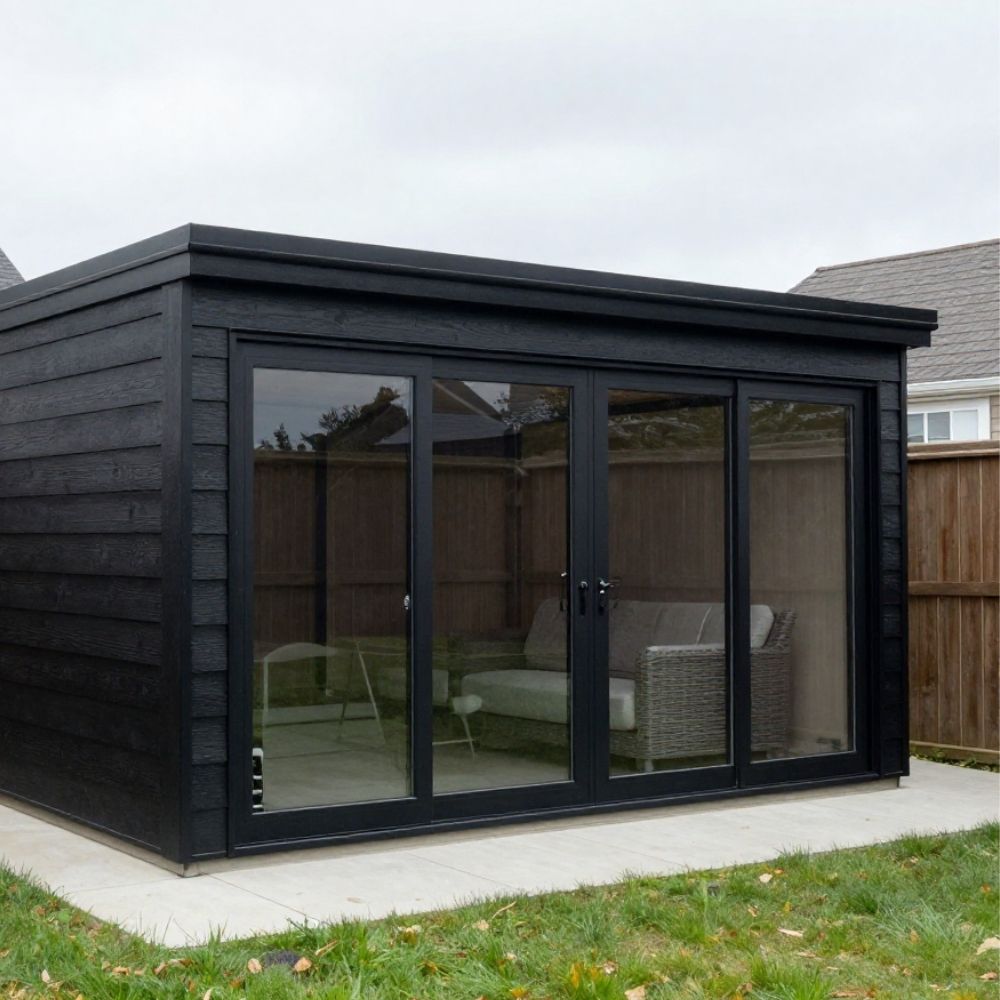
How Much Does a Garden Room Cost in Medway?
Garden rooms have moved firmly into the mainstream of home improvement across Medway over the past few years. What was once considered a premium addition to larger properties is now a realistic and frequently cost-effective option for a much broader range of homeowners — and the range of plots across Gillingham, Rainham, Sittingbourne Road and the newer residential developments on the edges of the conurbation means there is no shortage of gardens where a well-designed room could genuinely transform how a property is used.
The challenge is that the market for garden rooms spans an enormous range — from flat-pack structures assembled in a weekend at one end through to architect-designed, fully insulated buildings at the other. The price difference between these two extremes is significant, and so is the difference in how useful and durable the result turns out to be. Knowing what a properly built garden room should cost in Medway, and what determines where within that range your project sits, is the starting point for making a decision that you will not regret.
What Does a Garden Room Cost in Medway?
For a properly constructed, fully insulated garden room with electrics and a finished interior, realistic prices in the Medway area from a reputable local builder are:
- Small garden room (up to 12 sqm): £13,500–£21,000
- Medium garden room (12–20 sqm): £21,000–£34,000
- Large garden room (20–30 sqm): £34,000–£52,000+
These are complete installed prices covering everything from the base and foundations through to a finished, electrified interior. They do not cover high-end glazing upgrades, wet rooms, bespoke fitted furniture or specialist acoustic treatment — these are costed separately.
Medway sits at a broadly similar level to the wider Kent market on construction labour — above the rural parts of the county and in line with the Medway towns, but below the premium rates of the west Kent commuter belt and substantially below London. For ME4, ME5, ME7 and ME8 postcodes and the surrounding area, the figures above represent realistic current pricing.
What Drives the Price?
Foundations and Ground Conditions
Before a single wall panel goes up, the ground needs to be prepared — and the cost of that preparation varies considerably depending on what lies beneath the garden. Medway’s ground conditions are more varied than many homeowners expect. The higher ground across Rainham, Wigmore and the chalk ridge that runs through the borough tends to be firmer and better draining. Lower-lying areas — particularly those closer to the Medway Estuary, the Isle of Grain peninsula and the lower reaches of the Gillingham waterfront — sit on heavier soils that behave differently under load and are more susceptible to seasonal movement.
Gardens on former industrial land — and Medway has a significant legacy of dockyard and industrial activity across Chatham and parts of Gillingham — can occasionally contain made ground beneath what appears to be a normal lawn. This is not always a problem, but it affects what kind of foundation is appropriate and needs to be identified before work starts.
A standard concrete raft or pad foundation on stable ground typically adds £1,500–£2,500 to the project. On softer or more variable ground, engineered solutions add more — typically £3,000–£5,000. The only way to know for certain is for a builder to assess the ground before committing to a foundation type.
Size and Footprint
The relationship between floor area and cost is not perfectly linear — a 20 sqm room does not cost exactly twice as much as a 10 sqm room. Fixed costs like the base, the electrical connection and the door and window set are spread across a larger area as the room gets bigger, which means cost per square metre tends to reduce slightly as size increases. However, rooms that go beyond 30 sqm move into territory where planning permission is more likely to be required, which adds time and associated professional fees on top of the build cost.
Irregular shapes — L-shaped footprints, angled rooflines, non-rectangular plans — all add cost relative to a straightforward rectangle of equivalent area. If budget is a priority, a simple rectangular footprint is the most cost-effective approach.
Insulation Specification
This is the area where the gap between a good garden room and a disappointing one is most clearly felt — and the area where budget builds cut corners most aggressively. Medway is not the warmest part of the country. Cold winds from the Thames Estuary make winters in Gillingham and the northern parts of the borough noticeably colder than inland Kent, and an inadequately insulated garden room in this climate is a room that cannot be used comfortably for a significant part of the year.
The difference in annual heating costs between a well-insulated room and a poorly insulated one is substantial. A room with 100mm of rigid insulation in the floor, 100mm mineral wool or PIR in the walls, and 150mm or more in the roof retains heat effectively and needs modest heating to stay comfortable. A room with 50mm of budget insulation — common in cheaper kit builds — loses heat rapidly and requires continuous high-output heating to remain usable.
Upgrading from basic to proper year-round insulation typically adds £2,000–£4,000 to a medium-sized garden room. For a room used regularly, that additional cost pays back through reduced heating bills and improved usability within a few years.
Cladding and External Finish
The external cladding is both the most visible element of the finished building and one of the most significant variables in long-term maintenance cost. Three main options are worth understanding:
Treated softwood is the standard starting point and is included in base pricing. It looks attractive when new but requires maintenance — treating or staining every three to five years is necessary to prevent deterioration. In Medway’s maritime climate, particularly for gardens on the northern and eastern fringes of the borough where coastal exposure is more pronounced, softwood that is not properly maintained will show its age more quickly than in a sheltered inland location.
Siberian larch or western red cedar costs more — typically £1,500–£3,000 extra depending on the building size — but weathers naturally without intervention, lasting considerably longer and looking better as it ages. For a permanent garden building where low maintenance over the long term is a priority, the additional upfront cost is generally worth paying.
Composite cladding — either fibre cement or composite timber-effect boards — is the highest cost cladding option upfront, adding £2,000–£4,500 over a softwood specification. In exchange it is effectively maintenance-free for the life of the building. No treating, no staining, no year-five bill for renovation. For gardens in sheltered or shaded positions where timber is more prone to moisture retention and algae growth, it is particularly worth considering.
Doors, Windows and Glazing
The glazing specification is where a garden room’s aesthetic character is largely defined and where costs can move most sharply. A full-width aluminium bi-fold door set with double glazing — the most popular choice across Medway for the way it opens the room completely to the garden — currently costs £2,500–£5,500 fitted depending on the width and number of panels. Standard French doors cost less and suit certain building styles well. UPVC is cheaper still but tends to look out of place on a timber-clad structure.
Rooflights or roof lanterns are worth considering for rooms that do not receive direct south-facing light. A single quality rooflight fitted into a flat roof typically costs £500–£1,500. In the greyer months that characterise much of the Medway winter, additional light from above makes a meaningful difference to how pleasant the room is to use.
Electrical Installation
The base electrical specification — a sub-consumer unit, a circuit of double sockets, and ceiling lighting — is included in the figures above and is adequate for a home office or hobby room. Anything beyond this needs to be priced separately. Underfloor heating adds £1,500–£3,000. A split air conditioning unit that doubles as supplementary heating adds £1,500–£3,500. Data cabling and AV provision adds £300–£800. External lighting — path lights, security lighting — adds £400–£1,200 depending on the scope.
All electrical work requires sign-off under Part P of the Building Regulations from a registered electrician. This should be included as standard in any reputable builder’s quote. If it is not mentioned, ask — it is a legal requirement and not optional.
Internal Fit-Out
The standard internal finish — plasterboard or timber lining, painted walls, ceiling lighting and sockets — is what the price ranges above include. What goes into the room after that is up to you, but some additions have to be planned in at the build stage. Underfloor heating needs to be installed before the floor finish. A kitchenette requires plumbing roughed in during the build. A shower room requires waste and supply routes that need to be resolved before the base goes down.
A fitted home office with integrated storage and task lighting adds £2,000–£6,000. A kitchenette adds £1,500–£3,500. A shower room, if physically achievable given the distance from the house and the garden’s fall, adds £5,000–£10,000 depending on specification.
Planning Permission and Building Regulations in Medway
The majority of garden rooms across Medway’s residential areas fall within permitted development. No planning application is required provided the structure is single-storey, eaves height does not exceed 2.5m, overall height stays within 4m for a dual-pitched roof or 3m for any other, the building covers no more than half the garden area, and it is not used as self-contained residential accommodation.
Where permitted development does not apply — listed buildings, conservation areas, or properties where PD rights have been removed by a planning condition — a full application to Medway Council is required. Several parts of Medway carry conservation designations, including areas around the historic Chatham Dockyard and parts of the Medway Estuary. Newer residential developments, particularly on the peninsula to the north of Gillingham and across the Hoo peninsula, sometimes have article 4 directions or planning conditions that remove standard permitted development rights. If your home was built in the last 20 years it is worth checking your planning documents before assuming PD applies.
Building regulations approval is not required for most single-storey garden rooms under 30 sqm with no sleeping accommodation that are positioned at least 1m from any boundary. The electrical installation requires Part P sign-off in every case.
Is It Worth It in Medway?
For most Medway homeowners with a reasonable rear garden, the answer is straightforwardly yes. A well-built garden room changes how a property functions — adding dedicated space for working, training, creating or hosting that does not compete with the rest of the house. In a part of Kent where property values have risen consistently and where good local builders can deliver a quality build at a more accessible price point than the commuter belt to the west, the return on investment is generally strong.
The key is getting the specification right from the outset. A garden room built to a high standard — with proper insulation, quality cladding, good glazing and a solid electrical fit-out — is a building that earns its keep for decades. A building that cuts corners on any of those elements is one that disappoints within a few years.
If you are based in Medway — Gillingham, Rainham, Wigmore, Hempstead, Sittingbourne Road, Strood or the surrounding villages — we are happy to come out and look at your plot. We will give you a straightforward assessment of what is achievable and a clear quote based on what you actually want. Get in touch to arrange a visit.